Typing speed
Average WPM and How It Is Measured
WPM — words per minute — is the standard unit of typing speed. Its “words” are not real words: in English, one WPM word is a standard unit of five characters, including spaces and punctuation.
How is a “Word” Defined for WPM?
Real words vary in length, so they are not used for measuring typing speed. Instead, WPM treats every 5 keystrokes as one “word”, including spaces and punctuation. Actual words and their boundaries do not matter — the total number of keystrokes is simply divided by 5:
Every 5 keystrokes is one word
26 characters÷5=5.2 words
This is a widely used convention, but not a single universal standard. The convention most likely traces back to competitive typewriting.
In 1923, J. N. Kimball, a manager of the International World’s Championship Typewriting Contests, described designing2 test passages so that words would average five typewriter strokes each, making tests easier to compare and score.
Five is also close to the measured average length of an English word: 4.79 letters, according to Peter Norvig’s analysis3 of 743 billion words. This makes five a reasonable approximation for converting keystrokes into words per minute, although it does not establish the historical origin of the convention.
While the exact origin of the convention is not documented in a single definitive source, its use is well established across academic typing research and many popular typing tests and practice tools:
| Research / Tool | Type | What it uses | Source |
|---|---|---|---|
| Arif & Stuerzlinger (2009) | Research | 5 characters, spaces and punctuation included | Paper |
| Dhakal et al. (2018) | Research | “Any five characters” | Paper |
| Monkeytype | App | Characters ÷ 5 | Source·Docs |
| TypingClub | App | 5 characters per word | Methodology |
| Ratatype | App | 5 characters per word | Methodology |
| keybr | App | CPM ÷ 5 | Source |
Gross and Net WPM
There are two common ways to calculate WPM: gross and net.
- Gross WPM counts everything you type, including mistakes
- Net WPM adjusts to the number of mistakes
The gross formula is well established, but net WPM is not calculated the same way by every tool, because there is no single rule for what counts as an error.
20 characters−5 in the wrong word=15 characters
To give a few examples: Monkeytype counts only characters from correctly typed words, while TypingClub counts corrected mistakes as correct. Typing.com reports gross WPM and accuracy separately instead of calculating net WPM.
Why does this matter? A fast typist can get a high gross WPM by leaving mistakes behind, even though the final text needs more fixing.
A corrected mistake has already cost time through Backspace and retyping; an uncorrected mistake can make gross WPM look better without producing better text. Net WPM accounts for those remaining errors and therefore gives a better picture of usable typing speed.
What Counts as an Average WPM?
51.56 WPM is the average typing speed.
That figure comes from the largest published study of typing speed, but it needs some context.
The participants were self-selected visitors to a typing-practice website, not a representative sample of the general population. About two thirds were from the US and three quarters were between 11 and 30 years old. The authors note that this group is likely faster than the general population.1
The study measured English typing, so 51.56 WPM is an average for typing English, not for typing in general.
The average is also not the same as the midpoint. A small number of very fast typists pulls the mean upward, so about 50 WPM is closer to the speed of the person in the middle.
Where does your speed rank?
These benchmarks show how common different typing speeds are, from the middle of the distribution to the fastest typists.
Based on Typolo usage research and public sources.
How typing speed is distributed
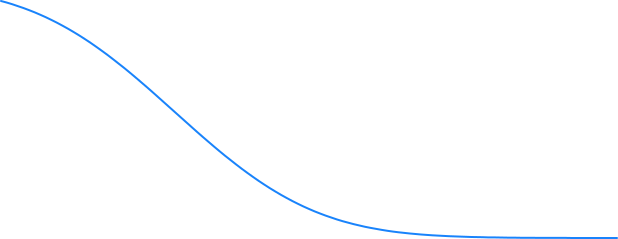
The curve below shows the share of typists who type faster than each WPM level. As speed increases, the number of typists who reach it drops sharply.

 2030405060708090100110120130
CPM and Languages Other Than English
The five-character “word” is an English-oriented measurement, built around English typing. Elsewhere it fits less well.
Languages such as German, Finnish, Hungarian, and Turkish have longer words, so five characters cover a smaller share of a real one. Some languages also need more than one keystroke per character, which tests like 10FastFingers must account for explicitly.
Characters per minute (CPM) avoids the problem by counting characters directly:
WPM = CPM ÷ 5
The downside is familiarity. 250 CPM and 50 WPM are the same speed, but WPM is the number people recognise.
Sources
- 1.Dhakal, V., Feit, A. M., Kristensson, P. O., & Oulasvirta, A. (2018). Observations on Typing from 136 Million Keystrokes. CHI ’18, ACM. doi:10.1145/3173574.3174220
- 2.Edward, W. G. (1923). Improvement Curves in the Learning of Typewriting. Toronto: The Ryerson Press. Records how J. N. Kimball composed the championship test passages. archive.org
- 3.Norvig, P. (2012). English Letter Frequency Counts: Mayzner Revisited. Word lengths over 743 billion words of the Google Books Ngrams corpus. norvig.com/mayzner.html
- 4.Arif, A. S., & Stuerzlinger, W. (2009). Analysis of Text Entry Performance Metrics. IEEE Toronto International Conference (TIC-STH ’09), 100–105. doi:10.1109/TIC-STH.2009.5444533